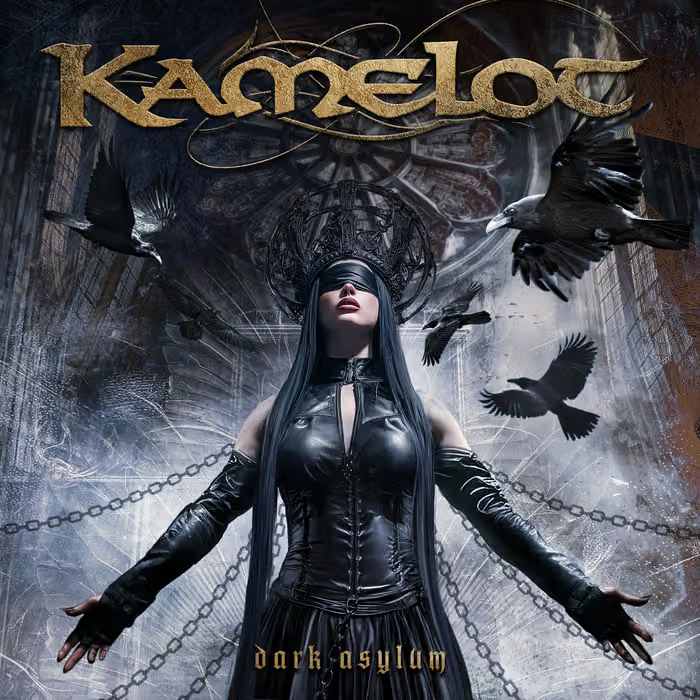
Symphonic power metal band Kamelot has officially cleared 30 years and counting of music with their recently released album Dark Asylum! I’m an enthusiastic fan of Kamelot both old and new (unlike our EpicFest 2026 reviewer), I love my niche metal genres, and I love a story, so I’m excited to dig into a new release that promises me all three. This post is best read after listening to the album, since I’ll be walking us through the album song-by-song with an analysis of the story and some brief musical commentary rather than doing a standard album review.
Dark Asylum is a concept album, and it’s a pretty complex one – there are repeated images and themes, lyrical motifs spread across songs, and details left up to interpretation rather than stated outright. It’s basically a literary analysis project, which I, a nerd, am loving. Treating this as a literary analysis project comes with a few caveats; the main one is that I’ve written this post as a cold read (and a cold-listen, obviously), meaning I’m working off just the music, the lyrics, and the band’s official descriptions. Any extra details from interviews and the music videos are not included.
So first off, what’s our setting here? It’s a concept album, but what concept are we exploring? Will this meet Powerful. co-host Fernando’s threshold for concept albums, because he insists that a true concept album should have repeated musical elements and not just the repeated lyrical ones? Per the band (via Napalm’s album description), our story starting point is:
Set within a shadowed Victorian-era world, Dark Asylum invites listeners beyond the gates of RavenHill Asylum—an imposing institution once built as a grand cathedral, now repurposed into a place where science, faith, and madness uneasily coexist. Candlelight trembles along towering arches and cold stone corridors as whispers echo through its halls, and behind every door lies a fragment of truth waiting to be uncovered. Identity fractures, reality bends, and control slips into unseen hands, guiding its central figure through a descent into psychological darkness that ultimately leads toward transformation… and perhaps sanctuary. […]
Once you step inside RavenHill… there is no turning back. Will you find sanctuary? Or will you wander its halls for eternity?
Musically, we have a much more concise summary from Napalm Records, which I’m counting as an official source because it’s the band’s label if not direct from the band itself.
KAMELOT expands its atmospheric reach on Dark Asylum, diving deeper into theatrical darkness while preserving the signature hooks that define their sound. (via Napalm)
Now that I’ve set out that baseline context, welcome to my song-by-song story analysis! C'mon, let's go tour the dark asylum.
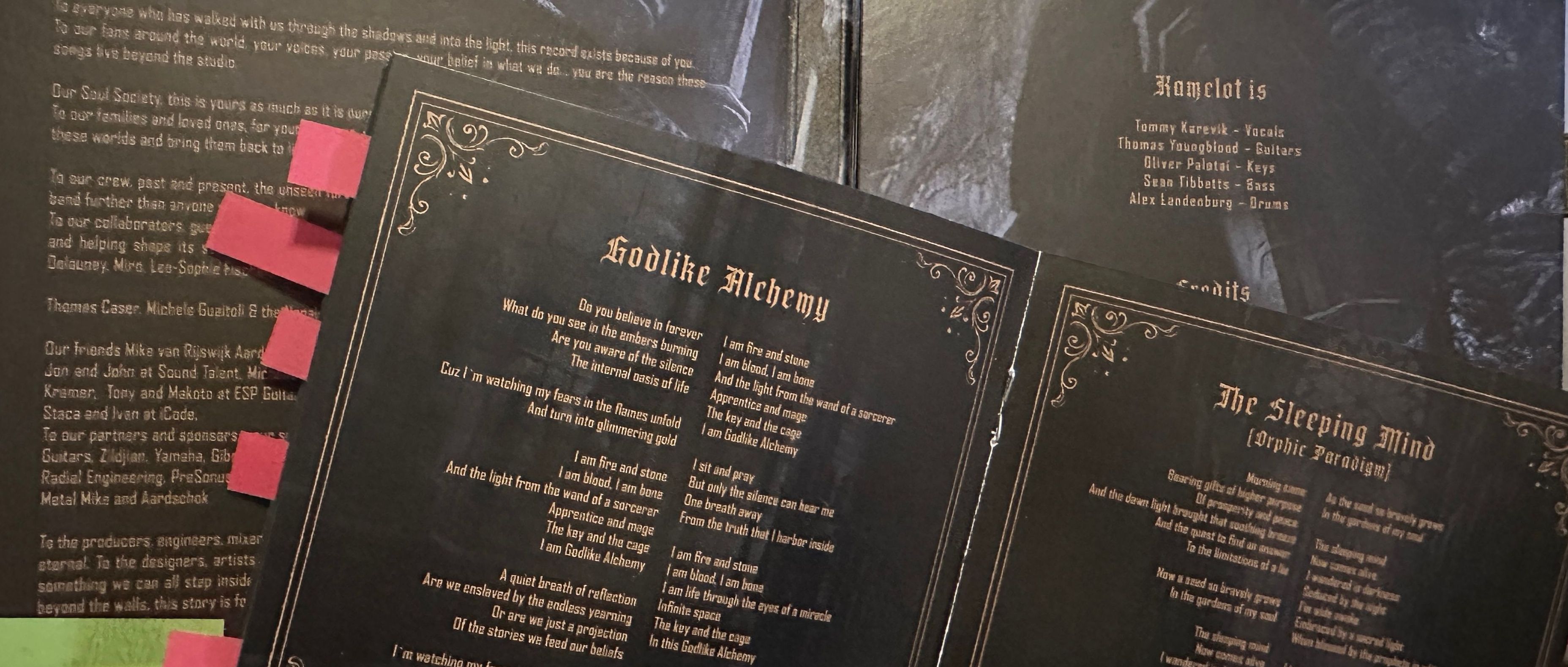
Pictured: being very normal about the opportunity to combine power metal and story analysis, two of my favorite things.
Sanctorium
Music: an intro track with narration and the sort of symphonic lead-in that Kamelot’s been doing for a few albums now. I’d bet money this is going to be the walk-on track for their Dark Asylum live shows. (Yes, I could look that up on setlist.fm, but I like the surprise setlist experience!)
Story: I sourced the lyrics straight from the CD booklet whenever possible, but the narration in this intro is not included in the CD lyrics booklet, which starts with Ashen World. It’s pretty relevant for story analysis, so for reference the narration says:
"We are prisoners, in a world of our own creation. Brick by brick, fear by fear, we built these walls around ourselves, a thousand silent doubts, a thousand whispered lies, until the prison felt like… home…"
That’s definitely not a metaphor or anything. It does segue nicely into the next track though!
Ashen World
Music: coming out swinging! I love a fast song, I really do. Great song to listen to while fighting to make your life better. Very enjoyable, though I would’ve liked to hear a little more from Ignacia Fernández, who’s mostly just there for the harshes. The piano line underscoring some of the verses is a nice touch.
Story: moving out of the “real” world and into RavenHill!
I’m a little surprised this is the first proper track on the album; from hearing it as a single, I would’ve thought it was a late-album story beat. Within the context of the album, though, it’s clearly the retreat from the larger world into the mysterious dark of RavenHill Asylum, the start of the journey. That’s kind of a gimme when the chorus opens with “Let’s escape / Escape this ashen world” and a later set of lines is “Oh – we leave them behind / We leave them all”.
The world we’re running from is clearly a harsh one, with lines like “the city bled dreamers” and “Where the wretched gods swallow / Every spark that would dare to illuminate pain”; those descriptions contrast sharply with the details about what we’re running to, with lines like “We’ll rebuild a realm from forgotten dreams / Where creation rises through fractured seams.” An intro narration about self-created prisons opening straight into a track about fleeing this grim ashen world to create something better? That checks out.
Dark Asylum
Music: Oh man this definitely has the Kamelot sound – we’ve got the guitar hooks, the dramatic vocals, a synth interlude, the existential angst. Yes thanks.
Story: Karevik’s character has entered RavenHill and, on moving from the ashen real world into this more metaphysical one, immediately been snared by his own existing pain. In this song we are working through some things in order to start the search for truth with a clean slate.
There are all sorts of lyrics to that end – “In this cathedral that I built / Black stone and mortal laced with guilt” is straight from the premise set out in Sanctorium, and lines like “the night becomes my kingdom” or the chorus’s decaying dreams bound by chains of memory reinforce the theme. “Welcome to the dark asylum, where we dance with yesterday”? Yes, this is definitely a story beat about needing to deal with the stuff that’s already in your head in order to clear a path to move forward.
I’m pleasantly surprised that the lyrics here (most notably “Release the tears I’ve tried to hide / So I can heal from deep inside”) specifically talk about healing via processing emotions; that’s different. A lot of classic Kamelot has focused on the experience of pain and not so much on ways to recover from it. The Khan-era albums in particular have a melancholy streak a mile wide and don’t get me wrong, I’ll listen to those any day, but sometimes one wants to stop being dramatically sad and figure out how to get on with things instead. Preferably with accompanying fast guitar.
Sanctuary
Music: pretty! It’s not going to be one of my favorites from the album, but it’s nice to listen to. Clémentine Delauney adds nicely ephemeral vocals, like we knew she would, and Fernández is back for more harshes in counterpoint. I enjoyed the multiple vocal lines and overall atmosphere.
I'm also a fan of a song that doesn't automatically go romantic with things. When this track was released as a single, with a title like Sanctuary and Delauney as guest vocals, I assumed it was going to be a ballad. Probably a ballad with romantic overtones, given both ballads in general and Kamelot's penchant for gothic romance. I was pleasantly surprised to find out it isn't. Three voices instead of two and a lyrical focus on "[m]y home, my friend" makes a nice change from romantic duets.
Story: moving on from the entryway, further into RavenHill – from the cathedral to a maze of doors and rooms, searching for truth and sanctuary.
We’ve recovered from the setbacks of the previous song (“Darkness took hold of me / You cut me free, my friend”) and moved onto the quest proper with determination (“But I keep walking / I won’t stop”).
The theme of connection comes back – Dark Asylum was an isolated track, with lyrics almost exclusively framed as “I” rather than “we” and no references to unspecified other people like in Ashen World. Here the chorus focuses on “my home, my friend” – the ties that anchor us and are pivotal in picking ourselves up and moving on.
We don’t really know who this friend is, but there’s been some other person in the narrative from the beginning – Ashen World refers to another person within the first verse (“carving your name in the marrow of night”), and uses “we” for a bunch of lines as well. A lot of this album is vibes so I don’t think it actually matters who the other person is, honestly, just that it’s someone our narrator cares about deeply enough to keep calling out to them on this journey. It’s a fairly smart choice from a writing perspective too – leaving a key role like Special Person as a vague outline means most people will mentally fill in the gaps with their own special person, so it becomes emotionally relatable to a wider range of people.
Nocte Veritas
Music: it’s an interlude track, it’s atmospheric, not much to say on the audio side.
Story: we can treat this as an intro to One Last Masquerade. There are no lyrics in the CD booklet for this one either, but my Latin is good enough to know "in nocte, veritas" means "in night, truth," possibly a callback to “in vino veritas,” literally “in wine, truth,” aka the age-old idea that alcohol brings out truths people might not say sober. The night also does that, if you’re doing it right.
The full chanted lyrics are:
In nocte, veritas / Sub persona, mendacium
Which leaves us a little flexibility to play with in the interpretation. "In nocte, veritas" is pretty straightforward as a translation and "sub persona, mendacium" is a little more complicated. “Sub” is a means under or beneath, it shows up in modern English words like subterranean or subpar, that one’s easy. We know the modern English definition of “persona” as a front or social façade someone puts on, but the Latin word historically means ‘mask’ or refers to the character played by an actor; in both versions there’s a distinct implication of incomplete truth, of something different under the mask. “Mendacium” is a lie, falsehood, or untruth. So that would give us a falsehood “under the guise of a lie” (if we ask Google Translate), or under the mask, a lie. In the night there is truth, under the mask of a lie? That seems fitting, considering the next song is called…
One Last Masquerade
Music: This track is a great illustration of the power music adds to stories – on paper the shift from the atmospheric vocals of “the shadows stretch, they grow so tall / I hear them whisper, I hear them call” in Sanctuary to the downbeat and heavy guitars around “shadows ignite” here isn’t that dramatic, but all the audio layers make it so much more striking. There’s so much more depth. Music is the best.
I also think it’s neat that Karevik had a guest slot on the most recent Avantasia album, and now here’s Sammet on Kamelot. The way the back-and-forth lines “Can you hear them calling you / I can hear them / Do you feel it?” resolve into a duet on “Do you feel alive?” is the highlight for me – extremely fun, love that.
Story: masks and costumes are being pushed aside, and we’re venturing further into the dark in search of truth.
The possible interpretations of the story start to split here. We could interpret the duet and opening lines of “Time has come for you to reconcile / Who’s the man behind that twisted smile?” as Karevik and Sammet representing conflicting parts of our narrator’s psyche – the album description does say “identity fractures” – but we could also take it at face value and interpret Sammet as another person, someone else encountered on the journey into the transformative dark. I’m more inclined to interpret it as the latter. That fits better with the nebulous sense of other people in the earlier songs, and ties into some of the later songs more smoothly.
“Put all your pain aside / And let your senses come alive” early in the song continues the story thread from Dark Asylum and Sanctuary; we’ve cleared out the chains of past memories, so now we have to actually grab onto the present. A lot of new imagery around masks and costumes is introduced; it’s a masquerade, masks come with the territory, but we also have lines about “Take me down those dusty roads / Of all of the costumes that you’ve sown” and mentions of marionettes and figurines. A “grand charade” is repeatedly mentioned in the chorus, which is thematically relevant because charades aren’t exactly lies but they’re pretty close, and we just had an interlude about finding truth under the mask of lies. Hmm. The “faceless crowd” in the chorus matches up with images used later in the album too.
Ivy, My Dear
Music: Hey, a ballad I actually like! Kamelot does get a lot of slack from me on ballads, as one of my favorite bands, but I also think they simply do ballads better than a lot of other bands. Karevik's vocals are certainly well-suited to them, and the band’s penchant for gothic themes adds more flair than the boring seemingly obligatory ‘I love my lovely love’ type of ballads tend to have.
Story: a straightforward story beat, human connection uplifting and anchoring across distances.
The lyrics are full of human closeness in platonic and romantic forms: “And though we are oceans apart / I’ll write this letter my friend, again and again / And I promise you / I’ll never let go” contrasted with “don’t ever let go” in the second verse and “Don’t tell me I’m only dreaming” in the chorus, and then "kiss me goodnight / under the moon" in the chorus and "And God knows I've treasured our memories / But I'll trade them all for one last kiss" in the final verse. I’m not an especially romantic person, but given that last one I have to sigh and come down on the side of more romantic than not.
I'm not sure who we're romancing exactly, since the only other reference to an ivy so far has been the line "Step into my humble domicile / Where poison ivy grows forever wild" in One Last Masquerade, and that's ivy as a dramatic backdrop instead of a person. Maybe it’s the mystery person implicitly mentioned in Ashen World. Maybe it’s someone we met during One Last Masquerade and are now having a moment with. Does it really matter, though? We are on a transformative journey and meeting people and being changed by people and whirling ever onwards.
Is this Ivy? We don’t know, she’s just here to successfully look dramatic. (x)
Godlike Alchemy
Music: Banger! A musically more straightforward song compared to some of the other tracks, but that’s not a bad thing. A bit slower-paced with some fun guitar.
Story: the emotional high note, part one! Our protagonist has achieved the transformative power wished for in Ashen World and declaims about it.
We don’t just have godlike alchemy, no – “I am Godlike Alchemy.” “I’m watching my fears in the flames unfold / And turn into glimmering gold” sure sounds like the kind of purifying change we were looking for in Dark Asylum too. Truth is so close (“One breath away / From the truth that I harbor inside”) and discovery is nigh!
The Sleeping Mind (Orphic Paradigm)
Music: I really like this one. Probably my favorite song on the album. It's exactly my kind of Dramatic, and it's got some musical kick to it. I hope this one goes onto the roster of songs played live! This type of song structure for Karevik's vocals is my personal favorite too. I think this specific balance between power in the chorus and variation in the verses really lets him show off his range and talent.
Story: the emotional high note, part two! Coming out swinging again with “Morning came / Bearing gifts of higher purpose / Of prosperity and peace” as the first lines and “The sleeping mind / Now comes alive” in the chorus. We’ve done it – purpose is achieved, new knowledge and awareness. A transcendent moment!
The song’s subtitle is an Orpheus reference! A journey to the underworld and back? Don't look back, or lose what you came here for if you do? Yes that is thematically relevant thanks, extremely so, enough that I appreciate that they only worked it into one line of the lyrics rather than going more heavy-handed with it. A song full of optimism and sought-for change taking root.
I also appreciated the contrast to the mostly nighttime imagery of Ivy, My Dear (the moon, kiss me goodnight, don’t tell me I’m dreaming) transitioning into the morning-waking-growth imagery here here. It’s symbolic. Plus it lends a sense of time passing, but only a vague one, which is nicely appropriate for a mythic journey.
We did it! Alchemy achieved! The sleeping mind is awake and in the light! So… that’s it, right? Quest success? Well…
Kaleidoscope
Music: This is also exactly the kind of high drama I like Kamelot for. Soaring chorus, fast guitar, existential themes, yes please can I have another? Bonus points for the little descending guitar riff right before the first and last choruses kick off with “I’ve seen the fall of an angel,” that’s a fun touch.
Story: Uh-oh, we’ve gone from referencing Orpheus to referencing Icarus between this song and the last. Something’s going wrong; the search for truth has been successful – “I’ve seen it all / In my kaleidoscope!” – but dissonance is creeping in and we’re right at the moment where the wings come off. The chorus isn’t all bad, we definitely have Icarus imagery with “I’ve seen the fall of an angel / Flying too close to the sun,” but we also have “I’ve seen an angel arise from the ashes / a phoenix on colorful wings” right after that. Fall and rise, cycles of repetition – weird, it’s almost like the song was named Kaleidoscope for a reason.
Personally I'd say trusting the "prophets in white" from the chorus of The Sleeping Mind is what sets up the metaphorical fall here, because what kind of mythic journey of self-discovery hinges on someone else’s prophecy? What kind of transformation of the self is rooted in external truths? No, the core of it has to be internal, or the change won’t take, and then we fall.
Enigma (Think of Me)
Music: Ballad #2! Some of the lyrics are a little silly, I admit ("You pulled me in / like a wild enigma"? Hmm) but it’s a nice song. Comforting, if a bit melancholy.
Story: we’re leaning on human connection again, but on the way back down. A counterpoint to Ivy, My Dear; where Ivy, My Dear was, between the lyrics and song, asking for a hand outstretched to help each other towards the light, Enigma (Think of Me) is a hand out in entreaty: think the world of me, don’t forget me, don’t let me be “a picture of a fading memory.”
Cassandra's Disease
Music: This one didn't really grab me musically. It’s fine? It’s a little uninspired compared to the rest of the album so far, even with the twinkly piano accents and Karevik’s dramatic intonation in the verses.
Story: I also had some trouble placing it in the story. The key phrase is in the chorus: “feel our Cassandra’s disease.” On my initial listen I had thought the line was “feel like Cassandra’s disease,” which is a whole different story; the Cassandra of myth was cursed, not sick, so feeling like Cassandra's disease would have meant… being the affliction that keeps Cassandra’s prophecies from being believed? What? Being a disease on a cursed mythological figure doesn’t really make sense…?
Cassandra’s disease as an affliction our character is suffering makes much more sense. If we’re feeling our Cassandra’s disease, our prophecies correct but forever dismissed and ignored, then it slots into the storyline much more neatly – Orphic quest to Icarus falling to a descent through Enigma (Think of Me) down to the low point here, where our character doubts and second-guesses his alchemic work, reneging on the promise and determination of earlier songs.
It’s the dark counterpart to Kaleidoscope. The imagery of going round and round in a jumble of thoughts and sights and ideas continues, but now it’s darkly jumbled words and thoughts ("with random syllables this eulogy I write") in contrast to the light and color and determination of Kaleidoscope.
“Regression of the world I know to be reality” seems like a key line here, oh no we’ve failed the quest for transformation and the regular reality we started with is reasserting itself, but the preceding line is “Farewell to all that made sense to me,” so it’s not that. Instead we’re off the map and going even further down the rabbit hole, setting up for the finale. There’s a little bit of foreshadowing there in the chorus – "Dancers in a dream / Actors in psychotic scenes" ties in lyrically to the masks-and-dancing imagery in both One Last Masquerade and The Puppet King.
Beneath the Moon (Tunglið)
Music: Pretty! A little unexpected as an interlude between metal songs, but I like it!
Story: I enjoyed this song, it's certainly pleasant to listen to, and it initially seemed out of place to me from a storytelling perspective. It’s in Icelandic and I do not know Icelandic, so I had no lyrics to lean on at first and had to extrapolate from just the audio and vibes. That won’t do for a story analysis, though, so I consulted the internet (thanks Google Translate).
My internet translation says the lyrics mean:
The moon watches over the silent earth
Drawing the ocean to its heart
In the silver light, my footsteps change
Time breathes in rhythm with me
What was, is buried in the sand
What will be, rises with the tide
Ah
Under the moon, life changes
The tides teach me to let go
I vanish—and find myself again
In a current that draws me home
The night sky slowly tears apart
Old names wash away
I learned to live in cycles
To die a little, so I might become whole
High tide and low—I am both
Refracted light in the ocean's darkness
No fear of change now
The moon knows who I will become
Under the moon, life changes
Nothing stands still forever
I follow the current onward
For change is my soul
So hah, on music alone I tentatively interpreted this one as a quiet moment to breathe and rebalance after the peak-to-depths trajectory from The Sleeping Mind through Cassandra's Disease, and the translation says I was right! The song just kinda feels like time in a quiet beautiful landscape, a pause to take a breath before going back to everything. We’ve bottomed out at the low point and found a more balanced, more sustainable approach, and now we’re going to take a deep breath and continue on.
The story continues to hit effective emotional notes, in my opinion – in my experience the transition from jagged highs-and-lows to a more balanced, cyclical approach is what it feels like to grow into a more stable and steady version of yourself. Forcing big personal changes or throwing yourself headfirst at existential problems only works so well; accepting that change is a process and trying to direct it over time does a much better job of making the changes stick.
The Puppet King
Music: a solid finale. The overall tone is darker but the performance is nicely layered between instruments and vocals, and I like the drum line driving forward steadily as the rest of the song revolves around it.
Story: after recuperating by the moonlit ocean in Beneath the Moon (Tunglið), we’re back out into the broader world, or debatably into someone else’s domain further in the RavenHill otherworld; I could make a case for either scenario, and would accept both at once if we’re mixing the layers of reality and metaphor the whole album’s been playing with. It’s not a grand success, it’s definitely not the story's good ending, but… it’s not a purely bad ending either.
If we're interpreting the story as a metaphor for the self, then I think the transformation was successful but incomplete; sometimes it be like that, going from intensive internal work back into the broader world. Sometimes your bright new certainty gets buffeted around by larger things. If we're interpreting it as an actual fantastical adventure, then we've either escaped the asylum back into the broader world which is ashen and harsh, or failed to find our way out (remember, the album description ends with “Will you find sanctuary? Or will you wander its halls for eternity?”) and are stuck wandering a fantastical world under the sway of the Puppet King.
Still, I think it’s an improvement overall – over the course of the album we’ve gone from night to twilight, isolation to an unnerving crowd, silence and guilt to broken voices singing. The alchemy may be incomplete but it’s not failed, not entirely. Unsettled angels gather(ed) here are still angels, and more lively than they were before when they were still and silent in the ashen world. There’s an entire verse about believing in hope and survival and cries into the void not being in vain, so despite the overall tone of the song and the discomfiting imagery (“Lucid nightmares / Quite obscene,” unkindred spirits and strange obsessions), there’s a path forward. If there’s still struggle left to do, well, puppet kings are probably easier opponents than wretched gods.
Sanctum Requiem
Music: Not much to say here, it’s an outro. There’s a slower piano reprise of the riff from The Puppet King (which will probably not satisfy Fernando’s “is it a concept album” requirements for musical repetition) that fades into more general symphonics. It’s a common Kamelot close-out and suitably dramatic as an endnote to me. No story to speak of.
--
So, did we make it out of the asylum? Did the character voiced by Karevik succeed in their journey? I think... partly. There were definitely truths uncovered and psychological wounds healing, we just didn’t stick the landing in the end. A case could be made for several endings, but with everything I’ve just said (and thank you for reading this far), I think my cumulative interpretation is that we didn’t make it out of RavenHill and are still wandering.
My bonus theory is that Sammet’s character from One Last Masquerade has turned out to be the Puppet King. The imagery matches – “puppets on a string” and shadows and broken voices singing in The Puppet King, our protagonist talking to someone with “marionettes and figurines” and “all of the costumes you’ve sown” and “Shadows ignit[ing] / When the night screams loud” against the backdrop of a faceless crowd. That’s neither here nor there, but the fact that I could go back through the lyrics and pick out specific details like that speaks well for the album’s overall cohesion.
Either way, the story has a deliberately incomplete ending, and y'know what, that suits the overall vibe and theme. Sometimes doing personal work feels complete on the inside and then bringing it back into the larger world gets rough around the edges, if we’re interpreting the story metaphorically, and if we’re interpreting the story literally then according to whole swathes of myth and fairytales getting stuck in an otherland is definitely a thing that can happen if you don’t get the quest quite right.
Final Review:
My criteria for evaluation are pretty simple. Does it sound good? Is it fun to listen to?
That’s a resounding yes from me – I love this album and I’m very excited to see the band come through on an album-specific tour. It’s gonna be so dramatic, in a good way. I liked the variety of songs across the album, I liked all the little musical details and stylistic choices, Karevik knocked it out of the park on vocals (again), I thought the overall sound stayed true to Kamelot's sound without being boring or repetitive, and I liked the range of guest vocals and guest instrumentals.
Does it successfully tell the story it promised, across the subcategories of lyrics, atmosphere, and cohesion?
Lyrics: yes!
Atmosphere: yes! To paraphrase one of my favorite internet posts, it very much has the feeling of a long wild night where the logic of the world turns apart into a shadow realm dominated by mystery beings and crazy jokes, which is true but we forgot about it. The album set out to create a specific atmosphere and I thought it did that very effectively, including shifts in the nuance from song to song.
Cohesion: I’d say mostly! It took me a few listens and some time reviewing lyrics to fully connect the varied songs on the storyline, and the music hopping from fast to slow to fast to folksy interlude to dramatic ending was occasionally confusing. That said, there’s a ton of imagery woven together really well through the whole album – I did not even get into the half of it, because this post is already very long! – and themes consistently evoked despite sometimes nebulous plot developments. I especially liked that connection was a theme woven into the whole story; it's not like Kamelot has never had lyrics about the ties that bind before, but seeing it as a theme woven through an entire album rather than a bonus track here and there is pretty cool.
In summary, I really like this album, I think it was very successful at what it set out to do, and I’m really excited for Kamelot to come through on tour later this fall. And hey, if you disagree with how I interpreted the story and lyrics, you’re more than welcome to come tell me why on the Powerful. social media!